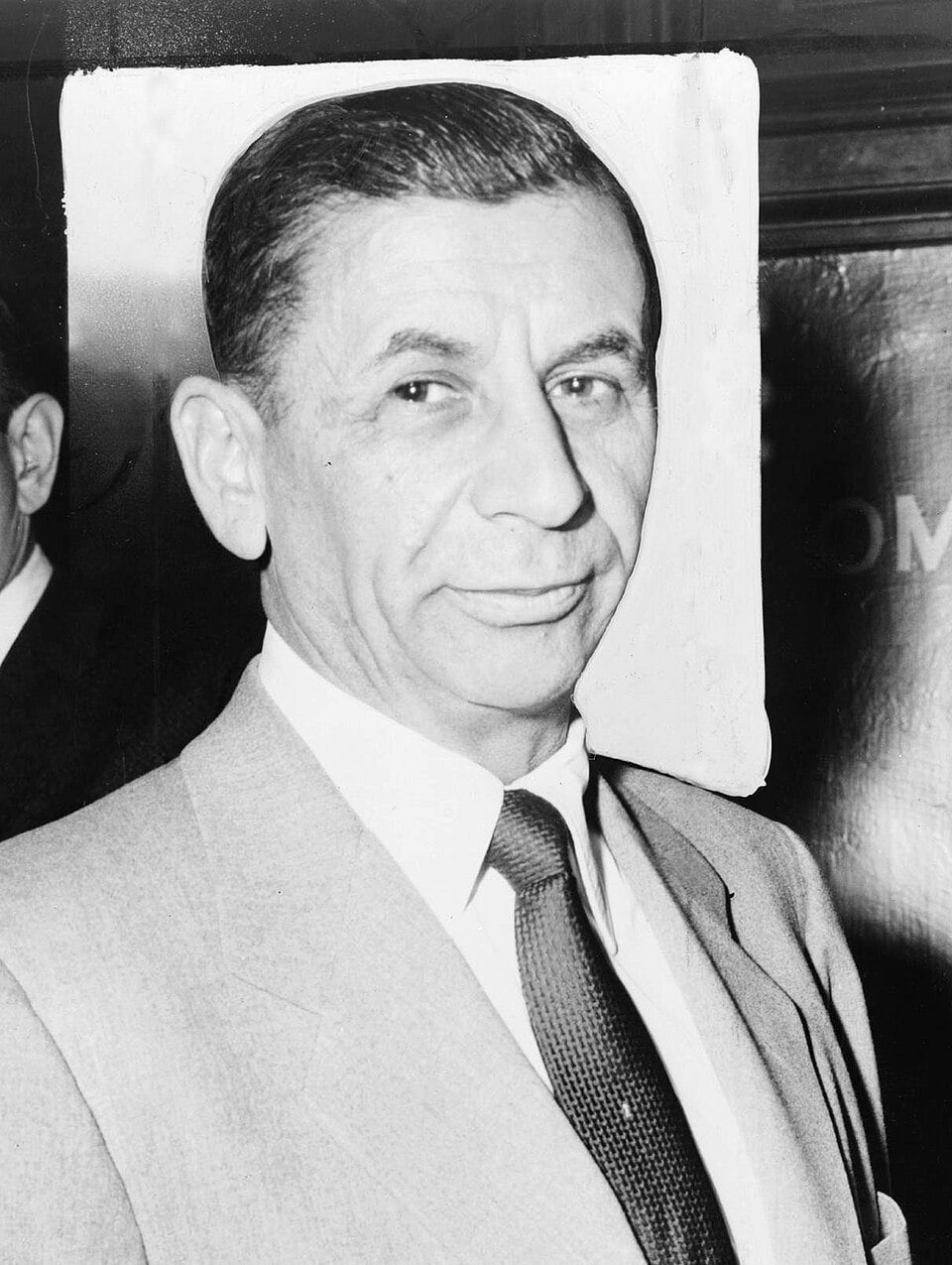
Meyer Lansky Net Worth
The gambling fortune that never turned up.
Last updated Nov 6, 2026 · 11 min read
Estimated net worth
$400 Million
USD · As of November 6, 2026
- Source of wealth
- Cuban casinos and racetracks before 1959, Las Vegas Flamingo Hotel stake, Florida and Louisiana gambling rooms, Swiss accounts and an offshore bank, Bahamas casino income after 1959
- Nationality
- United States
- Estimate
- Historical estimate by Net Worth Watch
What is Meyer Lansky's net worth?
Meyer Lansky's net worth is put at $400 million in today's money, valued on 6 November 2026. The figure describes the fortune attributed to him at his peak, the years when his gambling interests in Cuba, Las Vegas, Florida and Louisiana were at their height, restated in 2026 dollars.
The total consists of casino and racetrack interests rather than cash in an account: the Havana Riviera and the Montmartre Club in Cuba, a long interest in the Flamingo in Las Vegas, gambling rooms in Florida and Jefferson Parish, Louisiana, and money routed through Swiss accounts and an offshore bank he controlled.
It is an estimate, not an audited balance. Lansky kept few assets in his own name, his partners held stakes through intermediaries, and no complete set of accounts for his operations has ever surfaced. Comparable figures on this site are built the same way, from attributed sums rather than filed accounts. The gap between the peak and the endpoint is the point of this profile. When he died in Miami Beach in January 1983 he left no substantial estate, and investigators who had watched him for nearly fifty years never found the money the figure implies.
How the fortune was built
Maier Suchowljansky was born on 4 July 1902 in Grodno, then part of the Russian Empire and now in Belarus, into a Polish-Jewish family. In 1911 he travelled through Odessa with his mother and brother Jacob to join his father in New York, settling on the Lower East Side. There he met Benjamin Siegel, a lifelong friend and bootlegging partner, and Charles Luciano, who tried to extort protection money from him on the walk home from school and instead became an ally. The two ran the Bugs and Meyer Mob through Prohibition, and worked with Arnold Rothstein until his murder in 1928.
The turn came in May 1929, when Luciano, Lansky, Johnny Torrio and Frank Costello called a conference in Atlantic City that produced the network later called the National Crime Syndicate, in which Italian, Jewish and Irish gangs pooled resources. Lansky's speciality was money, not muscle. He shifted proceeds from illegal operations in New Orleans into Swiss accounts, and the 1934 secrecy law put a legal wall around those balances. By 1936 he had gambling operations in Florida and Cuba, built on a grasp of the mathematics of the games and on protection bought with bribes. He insisted the games ran straight, because a rigged joint kills repeat business. With Carlos Marcello and Frank Costello he held stakes in the Southport and Beverly Club casinos.
In 1946 he persuaded the Italian-American Mafia to install Siegel in charge of Las Vegas and became a major investor in the Flamingo. It lost money, the investors wanted Siegel killed, and Lansky twice argued for more time. Siegel was shot in Beverly Hills on 20 June 1947, and twenty minutes later Gus Greenbaum and Moe Sedway walked in and took control. The FBI later concluded he kept a substantial interest in the property for twenty years.
Cuba was the larger prize. He controlled the casino at the Hotel Nacional from 1937 and had renovated the Oriental Park racetrack casino for Fulgencio Batista, and the two reached an arrangement: kickbacks in exchange for mob control of the casinos and racetracks, with the government matching any hotel investment above $1 million and attaching a casino licence to it. That December he co-hosted the Havana Conference with Luciano at the Hotel Nacional. After Batista retook power in a 1952 coup he brought Lansky in as an adviser on gambling reform, and a 1955 change let any club or hotel worth $1 million or more run a casino. Lansky began the Havana Riviera in 1956, providing most of the $14 million it cost, and opened it in December 1957.
Assets and holdings
There was never a single company with Lansky's name on the door. What investigators describe is a lattice: an offshore bank he bought in Switzerland, holding companies that owned other companies, accounts shielded by the 1934 secrecy law, and stakes registered to associates rather than to him. The Cuban holdings were typical. He supplied most of the $14 million that built the Havana Riviera and then listed himself in the records as kitchen manager, and alongside it he held interests with associates in the Sevilla Biltmore, the Internacional, the Commodore and the Havana Hilton, and ran the Montmartre Club and its gambling school for young Cuban dealers.
In the United States the visible asset was not a title deed but a position. The FBI concluded that he kept a substantial financial interest in the Flamingo for two decades after Siegel's death, exercised through partners and successors including Greenbaum and Sedway. The Louisiana side ran through the Southport and Beverly Club casinos in partnership with Carlos Marcello and Frank Costello, and there were Florida rooms going back to the mid 1930s.
After Cuba the structure moved offshore again. Investigators suspected him of secretly owning the Lucayan Beach Casino at Freeport in Grand Bahama, and in any case he drew some income from the venture. He also bankrolled Lynden Pindling, who became Prime Minister in 1967 and eased his dealings in the islands. What remained in his own name at the end was a house in Miami Beach and very little else.
Income and the scale of the operations
The cash came from the drop, not from a salary. Casino and racetrack takings were counted nightly, skimmed before the books were made up, and moved out through accounts designed to be hard to follow. Lansky understood the house percentage better than the operators he financed, so a room with honest games still produced a predictable return, and protection payments kept it running.
Cuba was the biggest engine. The Batista arrangement meant the government matched every dollar of hotel investment above $1 million and attached a casino licence to it, so capital came back doubled in effect. Lansky put up most of the $14 million for the Havana Riviera and opened it in December 1957, and on New Year's Eve 1958 he was celebrating the $3 million it had made in its first year. His own businesses fed the same channel: the Montmartre Club, the gambling school that supplied trained dealers, and stakes in four other Havana hotels.
The Flamingo and the Louisiana clubs produced their own flows, and investigators treated the Swiss accounts and the offshore bank as the destination for all of it. After 1959 the Bahamas replaced Cuba as the source, on nothing like the same scale.
Where the money went
The largest loss was political. On New Year's Eve 1958, as Batista prepared to flee, Lansky was counting the $3 million his Riviera had earned in its first year. That night many Havana casinos, including several of his, were looted and destroyed. He fled to the Bahamas on 7 January 1959, left $17 million in cash behind, and his businesses were nationalised and shut down. Jake told Lansky's children not to expect a lot of money: if your father died today, he is broke.
Money also went into ventures that failed. In August 1960 he struck a deal in Miami with the former Cuban prime minister Tony Varona to bankroll a government in exile in return for the reopening of the hotels and casinos after Castro; it collapsed. The Flamingo swallowed capital for years before it turned. Bahamas interests were smaller and largely hidden.
Then came the costs of staying free: legal defence against tax charges, the move to Israel in 1970 and the deportation back, and a quiet retirement in Miami Beach. Robert Lacey, his biographer, describes those years as financially constrained and cites trouble paying medical expenses for a disabled son. No cache of hidden assets was ever found, and no forfeiture recovered one.
What the records actually show
The documentary base is thick on surveillance and thin on assets. The FBI investigated Lansky for nearly fifty years and produced reports on his movements, his associates and his casino interests, including the conclusion that he held a substantial Flamingo interest for twenty years. None of it is a balance sheet. Surveillance establishes relationships and suspicions; it does not establish what a man owned.
The court record is equally limited. When the government finally tried him for tax evasion after his deportation from Israel, its case rested on the testimony of the loan shark Vincent Teresa, and the jury acquitted him in 1973. In 1975 the mercenary Frank Sturgis testified that a Lansky associate offered him $1 million to assassinate Fidel Castro, which shows the size of the sums moving around him but nothing about his personal holdings.
What is left is inference. Robert Lacey's biography concludes that the wealth and the influence were exaggerated. Family accounts describe modest liquid assets at his death, but they are not independently corroborated, and no financial reconstruction has ever shown that Lansky concealed large sums. The $400 million is an attributed peak figure carried in 2026 money, not a number any document proves.
How that compares
Against the other crime fortunes on networth.watch, the number sits in the middle. Pablo Escobar is carried at about $30 billion in 2026 terms at his peak, roughly seventy five times Lansky's figure, and the difference is instructive: Escobar owned the product and the route, while Lansky took a percentage of other people's casinos and moved the proceeds offshore. Escobar's money was also physical, counted in shipments, which is why his peak figure can be argued from volumes.
Lucky Luciano, Lansky's partner from the Lower East Side, is carried at about $150 million in today's money, built on bootlegging, gambling and syndicate tribute. Luciano was the senior figure politically and Lansky the one who structured the money, yet Luciano's peak figure is lower, largely because he spent 1936 to 1946 in prison and was deported in 1946, cutting off his best earning years.
All three share the same problem. The figures reconstruct criminal income rather than record ownership, and in Lansky's case the end of the story is a modest estate rather than a hidden empire still intact somewhere offshore.
Net worth milestones
- 1929 The Atlantic City conference in May formalises the National Crime Syndicate, turning Lansky from gang operator into the money man for several families.
- 1932 Proceeds from illegal gambling operations in New Orleans begin moving into Swiss bank accounts, the first documented step toward an offshore structure.
- 1936 Gambling operations run in Florida and Cuba, with the Hotel Nacional casino under his control and the Oriental Park racetrack casino renovated for Batista.
- 1946 He becomes a major investor in Siegel's Flamingo and co-hosts the Havana Conference in December at the Hotel Nacional with Luciano.
- 1957 The Havana Riviera opens on 10 December, 440 rooms built with most of its $14 million cost supplied by Lansky, and earns $3 million in its first year.
- 1959 The revolution ends the Cuban operation; he flees to the Bahamas on 7 January leaving $17 million in cash behind him, and the casinos are nationalised.
Legal history and later life
For a man under scrutiny for nearly fifty years, the legal record is short. Lansky was convicted only of illegal gambling offences and was never found guilty of major financial or violent crimes, despite the investigations, the wiretaps and the testimony of men who worked around him. Prosecutors suspected he controlled far more than they proved, and never closed the gap in court.
In 1970, facing federal tax evasion charges, he flew to Herzliya Pituah in Israel, where the Law of Return let any Jew settle and Israeli law barred the extradition of citizens. The government reserved the right to exclude people with a criminal past, and after two years he was deported back. The government tried him on tax evasion on the testimony of Vincent Teresa, and he was acquitted in 1973.
Two episodes never produced a charge. Siegel's murder in June 1947 is widely believed to have needed Lansky's final approval, given his standing and their friendship, but no prosecution followed, and Lansky said later that if it had been up to him Siegel would have lived. In 1975 Frank Sturgis testified that a Lansky associate offered him $1 million to kill Castro, an account he said never went ahead for lack of approval from his contacts at the American embassy.
He retired to Miami and spent his last ten years quietly at his Miami Beach home. He died of lung cancer on 15 January 1983, aged 80, and was buried at Mount Nebo Cemetery; no hidden fortune was found.
Frequently asked questions
Did Meyer Lansky really have $400 million? Nobody has proved it either way. The $400 million is an estimate of what he controlled at his peak, in 2026 money, assembled from law-enforcement suspicion, journalism and later histories. No accounts, tax returns or seizure records support it, and Robert Lacey's biography argues the wealth was routinely exaggerated by writers and investigators alike. Read it as an order of magnitude.
Where did all the money go? Mostly into things that were taken away by politics and events. The Cuban casinos and hotels were nationalised after 1959, and he left $17 million in cash in Havana when he fled. The Riviera had cost $14 million and was gone within a year of opening. Later Bahamas ventures were smaller, and the Swiss structure was never pierced in a way that produced a recoverable sum.
Was Lansky ever convicted of anything? He was convicted of illegal gambling offences and nothing more serious, despite nearly fifty years of FBI attention. The most substantial attempt against him, a federal tax evasion prosecution after his deportation from Israel, ended in acquittal in 1973. He was never charged over the murder of Benjamin Siegel, and no charge arose from Frank Sturgis's 1975 testimony about a contract to kill Castro.
What was he worth when he died? Very little, in any documented sense. At his death in January 1983 he held few assets in his own name and left no substantial estate, and no verified cache of hidden wealth was ever identified. His brother Jake joked that if Lansky died he was broke. Investigators long suspected he still had access to money, but nothing was found to confirm it.
How did the Cuban operation work? Lansky and Batista reached an arrangement in the 1940s: kickbacks in return for mob control of the casinos and racetracks, with the state matching any hotel investment above $1 million and issuing a casino licence alongside it. That rule is why Havana hotel building surged after the 1955 change in the gambling law, and how Lansky supplied most of the $14 million for the Riviera.