Lucky Luciano Net Worth
The syndicate builder, valued in today's money.
Last updated Nov 6, 2026 · 11 min read
Estimated net worth
$150 Million
USD · As of November 6, 2026
- Source of wealth
- Bootlegging during Prohibition, Gambling, bookmaking and loansharking, Prostitution rackets and protection payments, Extortion, labour racketeering and waterfront control, Cuban casinos and narcotics trafficking
- Nationality
- Italy
- Estimate
- Historical estimate by Net Worth Watch
What is Lucky Luciano's net worth?
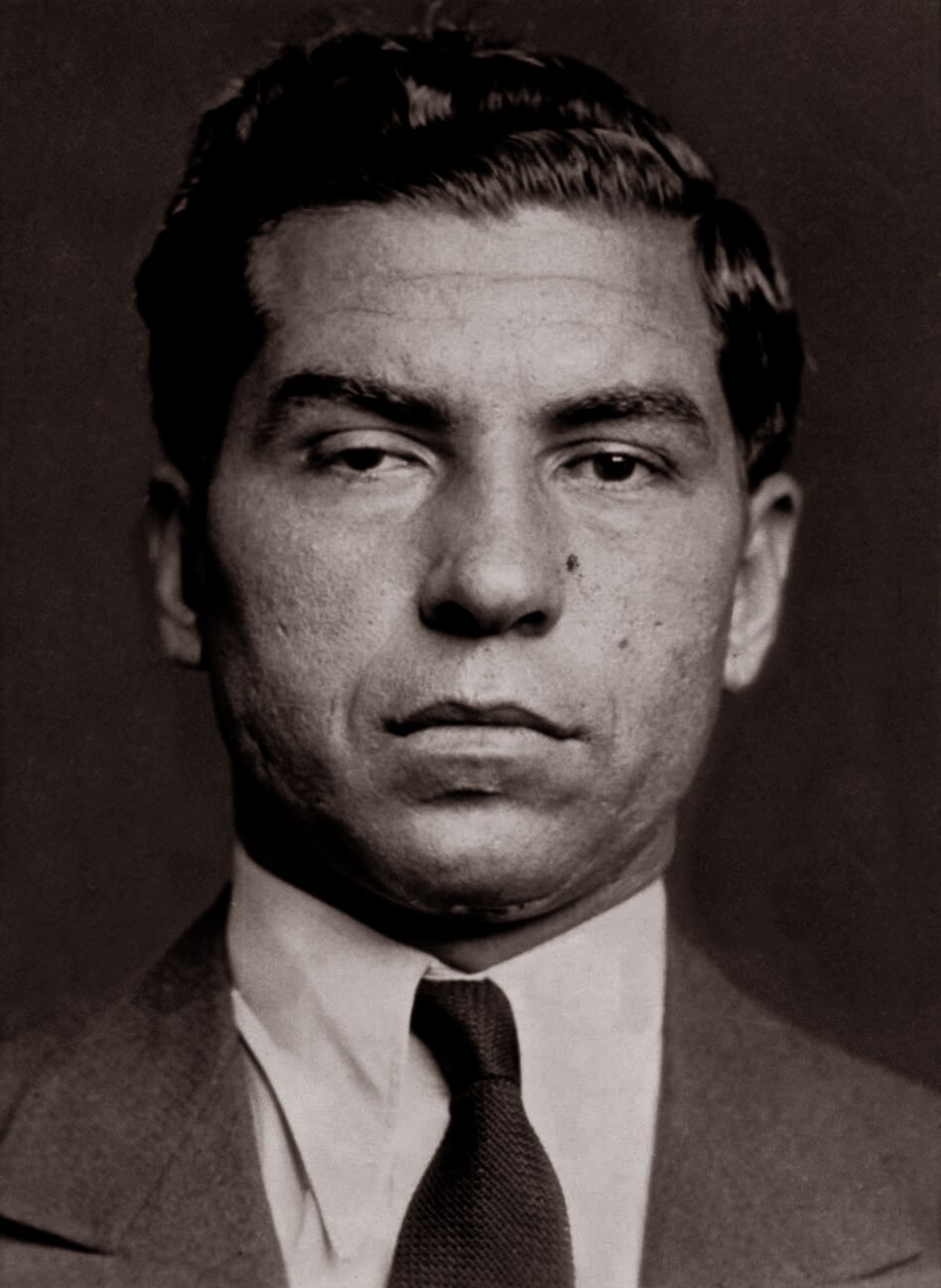
Lucky Luciano's net worth is put at $150 million in today's money, valued on 6 November 2026. The figure describes the fortune attributed to him at his peak, the years from the early 1930s to the mid 1950s when he stood at the centre of organised gambling, bootlegging and labour racketeering in New York, restated in 2026 dollars.
What it consists of is income rather than a portfolio. There was no company with his name on the door and no share register to consult. The total stands for the proceeds of bootleg alcohol in the 1920s and of the gambling, bookmaking, loansharking, extortion and prostitution rackets run by the crime family that carried his name, plus the Cuban gambling and hotel investments he held with Meyer Lansky in 1946.
It is an estimate, plainly stated. Luciano kept no accounts that survive, held what he owned through other people, and in 1936 could not explain to a court why his federal tax returns showed $22,000 a year while he lived in a suite at the Waldorf-Astoria. Prosecutors and later historians have reasoned about his wealth from the outside. The $150 million is an order of magnitude for a criminal enterprise, not a balance he could have produced on demand.
How the fortune was built
Salvatore Lucania was born on 24 November 1897 in Lercara Friddi, in the Sicilian interior, to Antonio Lucania and Rosalia Caffarella. His father worked in a sulphur mine and saved for years for the passage to America. In 1906, when Luciano was eight, the family emigrated and settled on the Lower East Side of Manhattan. He left school at fourteen to deliver hats for $7 a week, and quit after winning $244 in a dice game.
The street was his business school. He formed his own gang, joined the old Five Points Gang, and sold protection to Jewish boys for ten cents a week, which is how he met Meyer Lansky and began a partnership that lasted forty years. Between 1916 and 1936 he was arrested twenty five times on charges including assault, illegal gambling, blackmail and robbery, and served no time. When the Eighteenth Amendment took effect on 17 January 1920, Joe Masseria recruited him as one of his gunmen, and Luciano, Frank Costello and Vito Genovese started a bootlegging operation financed by the gambler Arnold Rothstein, who taught him to run liquor as a business rather than a racket.
By 1925 the operations were grossing over $12 million a year, reaching from New York into Philadelphia, and his personal income was about $4 million a year. In May 1929 he, Lansky, Costello and Johnny Torrio hosted a conference in Atlantic City that built the framework later called the National Crime Syndicate, in which Italian, Jewish and Irish gangs pooled their resources. That October three men pulled him into a limousine, beat and stabbed him and hung him from a beam in a Staten Island warehouse, an attack that left the scar and the drooping eye and very likely the nickname.
War made him the dominant boss in the country. After Gaetano Reina changed sides in 1930, Masseria ordered Luciano to arrange his murder, which took place on 26 February 1930 and opened the Castellammarese War. Luciano struck a secret deal with Masseria's rival, Salvatore Maranzano, and inherited the rackets when Masseria was shot at a Coney Island restaurant on 15 April 1931. He then had Maranzano killed in his Helmsley Building office on 10 September 1931. He abolished the title of boss of bosses, kept five families in New York, and later that year called a meeting in Chicago at which the bosses approved the Commission.
The rest was collection. His family drew from gambling, bookmaking, loansharking, extortion and drug trafficking, and he held influence in labour unions, the Manhattan waterfront, garbage hauling, construction, the Garment District and trucking. In the early 1930s the family took over small prostitution operations, the network Thomas Dewey later called the bonding combination, and a jury convicted him of running it in June 1936. Prison, deportation and exile followed, and none of it rebuilt the position he held in 1935.
Assets and holdings
There was no holding company, no trust and no property register in his name. What Luciano owned was an operating position: a share of the take from rackets that ran under the protection of his family, and the authority to settle who worked which territory. The structure was personal and hierarchical. He was boss, Vito Genovese was underboss until he fled to Naples in 1937, Frank Costello was consigliere and then acting boss, and men such as Joe Adonis, Willie Moretti and Anthony Strollo ran crews. Lansky, being a non-Italian, could hold no official post and acted as a top adviser instead.
His personal assets were deliberately unimpressive on paper. He lived in hotels under aliases, at the Barbizon-Plaza from 1927 as Charles Lane and later in a suite at the Waldorf-Astoria, which is where one trial witness said he hired a collector to work the bookers and madams. Cash, jewellery and clothes were the visible forms of wealth.
The real holdings were offshore and in other names. By 1946 he was already a major investor in Cuban gambling and hotel projects, and when he reached Havana that October he moved into an estate in the Miramar district. Lansky proposed that Luciano and Siegel put up half a million dollars to fund his casinos, and delivered the money to Fulgencio Batista, whose government was guaranteed $3 million or $5 million a year. In Italy he kept a house in Naples and, according to investigators, speculated in Palermo real estate with local Mafia figures.
Income and the scale of the operations
Cash arrived as tribute rather than as profit. Crews running bookmaking, brothels, loansharking and waterfront and garment protection passed a share upward, and the boss took from the top of that flow. The Commission he created in 1931 was not a company with a treasury; it was a standing agreement among bosses to settle disputes, allocate territory and stop wars from interrupting earnings, and its first serious test came in 1935 when it ordered Dutch Schultz killed rather than allow him to murder Dewey and bring a crackdown on everyone.
The scale is best read from the one set of figures attached to him. In 1925, at the age of twenty seven, his operations grossed over $12 million and he personally took about $4 million, in dollars of a period when he had earned $7 a week delivering hats. That is the income of a man who owned the wholesale layer of gambling and liquor in the largest city in the country, not a man collecting a wage.
The loose cash stayed visible for decades. In June 1951 Naples police questioned him for twenty hours over $57,000 in cash and a new American car brought into Italy, then released him without charge. His declared income in the United States remained $22,000 a year right through the period when he was living in the Waldorf-Astoria.
Where the money went
The first call on the money was the state, and he lost that argument. Dewey put his federal tax returns before the jury in 1936, showing $22,000 a year against a life lived in suites, and used the contradiction to destroy his credibility on the stand. The court then set bail he could not meet: a $350,000 bond after his arrest, which he failed to post, so he went to jail rather than home. His appeals ran to the Supreme Court, which refused to review the case in October 1938.
Prison was the largest financial loss of his life. Ten years, from 1936 to 1946, removed him from daily control, and the family was run first by Genovese and then by Costello. Deportation in February 1946 cut him off from the country where his assets sat. Within a year he had also lost Cuba: he had money in Havana casinos and hotel projects, and in February 1947 the Cuban government put him in custody and shipped him to Italy after the United States threatened to block narcotic drug shipments.
His later cash went out as politics and living costs. He is alleged to have paid part of $100,000 to a Puerto Rican drug dealer to falsely implicate Genovese in a narcotics deal in the late 1950s. The rest went on hotels, travel, a house in Naples and a car shipped into Italy. No forfeiture or probate inventory was ever published.
What the records actually show
The only sworn financial document attached to Luciano is the tax record Dewey produced at trial, which showed $22,000 a year. That figure is evidence of concealment, not of wealth; it tells you what he was willing to declare, and nothing about what he held. The trial record itself is thin on money. Three prostitutes identified him as the man the ring answered to, and all four women who implicated him, among them Florence Brown, recanted after the verdict.
Selwyn Raab, in Five Families, wrote that the evidence Dewey presented was astonishingly thin and that extortion would have been the more appropriate charge, and Joe Bonanno denied in his own book that Luciano was directly involved in prostitution. Against that sit the witnesses who quoted him calling the trade a chain store operation and ordering a brothel cracked when it fell behind on payments.
The memoir material cannot carry weight either. The Last Testament of Lucky Luciano, published after his death, was reported by the New York Times to quote him on events that happened years after he died. Italian police files are sober and just as inconclusive: a 1949 arrest in Rome released without charges, the $57,000 in cash in 1951, and a 1954 order restricting his movements. None of it measures an estate, because no estate was ever inventoried.
How that compares
Two other crime fortunes on networth.watch make the scale plain. Meyer Lansky, his partner from the Lower East Side and the man who structured the money behind the syndicate, is carried at about $400 million at his peak in today's money, roughly two and a half times Luciano's figure. That ranking is not accidental. Lansky spent the 1940s and 1950s building casinos in Havana and Las Vegas and moving proceeds into Swiss accounts, while Luciano spent 1936 to 1946 in a New York state prison and the rest of his life under Italian police restrictions.
Pablo Escobar sits far above both at about $30 billion, some two hundred times Luciano's number. The difference is structural rather than personal: Escobar owned the product and the route into the consumer market, so a commodity with a known price and volume could be multiplied into a figure. Luciano owned permissions inside a city, which generate steady income but nothing that compounds into capital. All three numbers are reconstructions of criminal income rather than records of ownership, and none of them could be produced as a bank balance by the men they describe.
Net worth milestones
- 1920 Prohibition begins on 17 January; Luciano joins Joe Masseria's crew as a gunman and starts a bootlegging operation with Frank Costello and Vito Genovese, financed by Arnold Rothstein.
- 1925 His New York operations, reaching into Philadelphia, gross over $12 million a year, with about $4 million a year in personal income.
- 1931 The Castellammarese War ends with Masseria dead in April and Maranzano dead in September; the five families and the Commission follow, and he is the dominant boss in the country.
- 1936 Convicted on 62 counts of compulsory prostitution on 7 June and sentenced to 30 to 50 years on 18 June, with tax returns showing $22,000 a year.
- 1946 Deported in February after Dewey commutes the sentence; by 29 October he is in Havana with a half million dollar casino investment behind him.
- 1947 Expelled from Cuba in February and arrested at Genoa on 11 April, ending his direct hold on the Cuban gambling and hotel interests.
Legal history and later life
Luciano was arrested twenty five times between 1916 and 1936 and served no time until the prostitution case broke the pattern. Special prosecutor Thomas Dewey, appointed by Governor Herbert Lehman in June 1935, built that case with his assistant Eunice Carter. Raids on 200 brothels on 2 February 1936 produced 87 women and 16 men under arrest, and Luciano was taken in Hot Springs, Arkansas on 3 April 1936 on a warrant charging 90 counts. An attempt to bribe the Arkansas attorney general with $50,000 was refused.
The trial opened on 11 May 1936. On 7 June he was convicted on 62 counts and on 18 June sentenced to 30 to 50 years. He ran the family from Sing Sing and then Clinton, and during the war the Navy dealt with him through Lansky about security on the New York waterfront, an arrangement known as Operation Underworld. On 3 January 1946 Dewey commuted the sentence on condition that he not resist deportation, and on 10 February he sailed from Brooklyn.
Italy kept him under surveillance for the rest of his life. He was arrested at Genoa on 11 April 1947 and released, arrested in Rome in July 1949 and released without charge, questioned over $57,000 in cash in 1951, stripped of his passport in 1952, and confined to Naples with a nightly curfew from 1954.
Luciano died of a heart attack at Naples Airport on 26 January 1962, aged 64, while waiting to meet the producer Martin Gosch about a film of his life. Italian drug agents had followed him there intending to arrest him for smuggling. His body was flown home with government permission to Saint John Cemetery in Middle Village, Queens. He was never tried on a narcotics charge.
Frequently asked questions
Was Lucky Luciano a billionaire? No. The fortune attributed to him at his peak comes to about $150 million in today's money, valued on 6 November 2026. Organised crime at his level produced very large annual income, but that income was split with crews and other bosses and spent on legal defence and living costs. Nothing in the record suggests a billion dollar position.
How did Lucky Luciano make his money? Bootlegging came first, financed by Arnold Rothstein, and by 1925 his New York and Philadelphia operations were grossing over $12 million a year. After 1931 he drew tribute from gambling, bookmaking, loansharking, extortion and prostitution across the five families he helped create, and from influence over unions and the Manhattan waterfront. In 1946 he added Cuban casino and hotel investments.
Why was Lucky Luciano deported to Italy? He was convicted in 1936 of compulsory prostitution and sentenced to 30 to 50 years. In January 1946, after his wartime cooperation with naval intelligence, Dewey commuted the sentence on the condition that he not resist deportation. Two federal agents moved him from Sing Sing to Ellis Island on 2 February, and his ship sailed from Brooklyn on 10 February, reaching Naples on 28 February.
What was Lucky Luciano worth when he died? There is no reliable figure and no published estate. He died at Naples Airport in 1962 living under Italian police restrictions, with his American holdings out of reach since 1946 and his Cuban investments gone since 1947. Police had questioned him over $57,000 in cash in 1951 but filed no charge. Every number offered for his death is an inference rather than a record.
Was he really guilty of running a prostitution ring? A jury convicted him on 62 counts in June 1936, and that verdict stands as the legal outcome. The case has been questioned since: all four women who implicated him recanted, Selwyn Raab called the evidence astonishingly thin, and Joe Bonanno denied any direct involvement. Other witnesses quoted him discussing the trade as a syndicate and ordering a brothel punished for late payments.