Al Capone Net Worth
Prohibition money, converted into today's dollars.
Last updated Nov 6, 2026 · 11 min read
Estimated net worth
$1.5 Billion
USD · As of November 6, 2026
- Source of wealth
- Prohibition bootlegging, Illegal breweries and bottling plants, Gambling and brothel revenue, Cicero and suburban territory, Political protection and graft
- Nationality
- United States
- Estimate
- Historical estimate by Net Worth Watch
What is Al Capone's net worth?
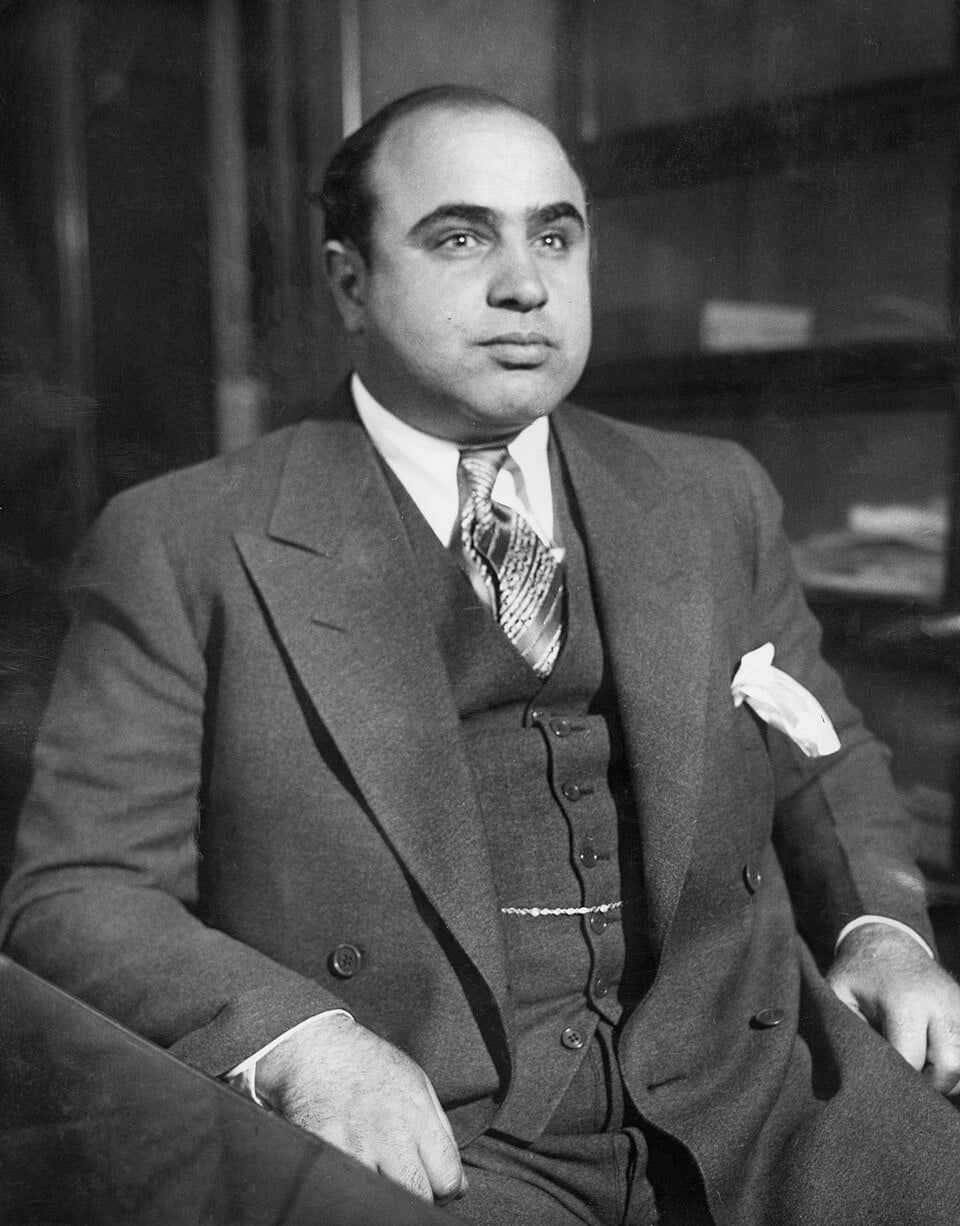
Al Capone's net worth is put at $1.5 billion in today's money for what he controlled around 1927, valued on 6 November 2026. The figure is not a personal bank balance. It is an estimate of the Chicago Outfit as a going concern at the height of Prohibition in that year: the illegal breweries, the bottling plants run in his brother Ralph's name, the transport network that reached Canada, the drinking establishments that took his beer, and the gambling and vice operations that paid for the right to trade.
Capone was 26 when he took over the organisation in 1925 and 33 when he entered prison. In those years he commanded cash flows that no auditor ever saw. The only figures tested in court were his own taxable income for 1925 to 1929, put by the government at $1,038,654, on which it said he had evaded $215,000. Everything above that is reconstruction.
The $1.5 billion should be read as an order of magnitude for a criminal enterprise, not as money he could have withdrawn. He was convicted of tax evasion in 1931, served almost eight years, and died in 1947 with no estate of that size on record.
How the fortune was built
Alphonse Gabriel Capone was born in Brooklyn on 17 January 1899 to Italian immigrants from Angri, near Naples. He left school at 14 and fell under the influence of the racketeer Johnny Torrio, who became his mentor. He joined the Five Points Gang and worked the door at Frankie Yale's Harvard Inn, where a knife fight left him with scars and the nickname he loathed.
In 1919 Torrio brought him to Chicago, where Torrio ran the syndicate of James "Big Jim" Colosimo, and Capone began as a bouncer in a brothel. Colosimo was murdered on 11 May 1920, in a killing in which Capone was suspected of involvement, and Torrio took the empire with Capone as his deputy. The organisation supplied illegal alcohol, protected through the Unione Siciliana.
The decisive transaction was not a purchase but an inheritance. An ambush in January 1925 left Capone unhurt, and twelve days later Torrio was shot while returning from a shopping trip. Torrio recovered, effectively resigned, and handed control to Capone, then 26. What passed to him was concrete: illegal breweries, a transportation network reaching Canada, and protection from politicians and police. He used it harder than Torrio. Establishments that refused to buy his liquor were bombed, and as many as 100 people died in such bombings in the 1920s.
He built territory rather than a single trade. Through bribery and intimidation he took over town council elections in Cicero, Illinois, giving the Outfit a base outside Chicago's wards. He bought a two-flat house at 7244 South Prairie Avenue for $5,500, and in 1928 paid $40,000 to Clarence Busch of the Anheuser-Busch family for a house on Palm Island, Florida. In 1927 he was credited with helping elect William Hale Thompson, on a platform of not enforcing Prohibition.
Violence was a cost and a means of growth. After the murder of Dean O'Banion in 1924 the North Side Gang pursued Capone for years: the Hawthorne Inn was shot up in September 1926 and Hymie Weiss was killed that October. Joe Aiello, who posted a $50,000 bounty on Capone in 1927, was himself shot in 1930. The Saint Valentine's Day Massacre of 14 February 1929, when seven men were lined against a wall at 2122 North Clark Street, was widely assumed to have been ordered by Capone.
The massacre destroyed the arrangement the fortune depended on. On 19 March 1929 the publisher Walter A. Strong and Frank Loesch of the Chicago Crime Commission met President Herbert Hoover, who directed federal agencies to concentrate on Capone. The Treasury and Justice Departments built income tax cases instead of trying to prove bootlegging. On 17 October 1931 a jury convicted Capone on five counts of tax evasion.
Assets and holdings
Capone's wealth was held as control rather than as title. The Outfit was a set of operating agreements: breweries that made the beer, a haulage network that moved it, retail accounts that sold it and crews that guaranteed both. Almost none of that appears in his name. His brother Ralph ran the bottling companies, legal and illegal, and acted as the public front man for the organisation until he was imprisoned for tax evasion in 1932. The value sat in the accounts, the routes and the protection, none of it sellable as a share.
What he owned personally is documented and modest. The two-flat building at 7244 South Prairie Avenue on a double lot, bought for $5,500 in the early 1920s. The 10,000 square foot mansion at 93 Palm Avenue on Palm Island, between Miami and Miami Beach, bought for $40,000 in 1928 and used as a base away from Chicago. Beyond property, the holdings were cash and consumption: custom suits, cigars, jewelry, and the private train cars and hotel suites he used to disappear for a week under assumed names.
The structure that mattered was political. Cicero's town council, won through bribery and intimidation, and the alliance with Mayor Thompson functioned as the licence under which everything else operated. When federal pressure arrived in 1929, that licence was the first asset to lose its value, and the breweries and routes went with it. What remained was property he actually held: two houses, and a name newspapers would pay to print.
Income and the scale of the operations
The cash came from beer. Prohibition closed the legal saloons and left the supply of alcohol to whoever could brew it, move it and protect it, and the Outfit did all three. What Capone inherited in 1925 was a set of illegal breweries and a transport network that reached Canada; the retail side was the city's drinking establishments, which bought from him or were bombed. Gambling and brothels added revenue.
The only income figures on the record are the ones his own lawyer supplied. After Ralph was convicted of tax evasion in 1930, Capone ordered his lawyer to regularise his position. The lawyer wrote to the government conceding substantial taxable income for years in which no tax had been paid, including $100,000 for 1928 and $100,000 for 1929. The government then charged him with evading $215,000 of tax on total income of $1,038,654 for 1925 through 1929.
Those numbers describe one man's conceded slice, not the enterprise. It was an income far beyond what most Americans saw in the same years, and still only what could be admitted without opening the books. On that showing the enterprise behind him was worth many multiples of his declared share.
Where the money went
Most of it went out again. The Outfit ran on payroll: gunmen, drivers, lookouts, lawyers, bail, and the payments that kept police and politicians useful. Thompson allegedly took a $250,000 campaign contribution in 1927. Bombing a rival's premises was a recurring expense. Capone spent on custom suits, cigars and jewelry, and on privacy, buying up a Pullman sleeper car for a night train to Cleveland, Omaha or Hot Springs and then a week in hotel suites under assumed names.
The recorded purchases are small against the enterprise: $5,500 for the South Prairie Avenue house, $40,000 for Palm Island in 1928. There was also charity, including a soup kitchen opened in February 1931 and, after his release, two Japanese weeping cherry trees donated to the Baltimore hospital that treated him.
The largest single outflow was the state's. On conviction in October 1931 he was fined $50,000, ordered to pay $7,692 in court costs, and held liable for $215,000 plus interest in back taxes, while beginning an 11-year sentence. The real loss was the business. He ceased to be boss the moment he was imprisoned, and Frank Nitti took over the Outfit after his own release from prison in March 1932.
What the records actually show
The $1.5 billion is a reconstruction, not a document. No accounts of the Chicago Outfit have survived, and the enterprise was built to leave none: liquor moved through breweries and bottling plants fronted by relatives, and Ralph Capone was the named front man until his own conviction in 1932. Cash moved through hands rather than ledgers.
The documents that do exist measure something much narrower. The 1931 tax case produced the government's calculation of $1,038,654 in income and $215,000 in evaded tax for 1925 to 1929, and it produced the 1930 letter from Capone's lawyer admitting $100,000 of income for 1928 and for 1929. Much was later made of witnesses and ledgers, but that material strongly implied Capone's control of the operations rather than stating it. The conviction rested on his own admissions, let into evidence by Judge Wilkerson over the objection that a lawyer cannot confess for his client.
His 1932 FBI criminal record shows most of the charges against him discharged or dismissed, a reminder that arrests and convictions are different things. Nothing verifies the 1927 market value of the breweries, the haulage network or the retail accounts, and no probate inventory of his estate is in the record.
How that compares
networth.watch puts Lucky Luciano at $150 million and Meyer Lansky at $400 million in today's money, both drawn from the same category of Prohibition-era organised crime. Capone's $1.5 billion is ten times Luciano's figure and a little under four times Lansky's.
The gap is mostly timing and scope. Capone's number is attached to an enterprise at its height in 1927, when he controlled production and distribution across a metropolitan area with a protected political machine behind him. Luciano's is attached to a man whose operations ran through families and shared territory, and who spent 1936 to 1946 in prison. Lansky's is casino money, channelled through partnerships, front men and offshore structures, and almost nothing of it was found after his death.
None of the three figures has been audited, and each rests on a different method. Capone's is the largest because a bootlegging monopoly in one city, priced as a going concern, is worth more than a share of several. Repeal removed the product in 1933, so each figure marks a moment rather than a fortune that could compound over decades.
Net worth milestones
- 1919 Moves from New York to Chicago at Johnny Torrio's invitation and starts as a bouncer in a brothel, his entry into the syndicate that becomes the Outfit.
- 1925 Torrio is shot and resigns, handing Capone, aged 26, the illegal breweries, the Canada route and the political protection that make the fortune.
- 1927 Helps elect William Hale Thompson on a wet platform, with a $250,000 contribution alleged, while Joe Aiello posts a $50,000 bounty on his life.
- 1928 Buys the Palm Island mansion in Florida for $40,000, the clearest documented asset purchase of his career, and his bomber attacks polling places on 10 April.
- 1931 Convicted on 17 October of five counts of income tax evasion on $1,038,654 of income, then fined $50,000 and sentenced to 11 years.
- 1939 Paroled on 16 November after almost eight years, his health ruined, with the Outfit under Frank Nitti and no personal estate of note.
Legal history and later life
Capone's record is a long series of arrests that mostly did not stick until the tax case. Federal agents arrested him on 27 March 1929 for contempt after he feigned illness to avoid testifying. On 16 May 1929 he was arrested in Philadelphia for carrying a concealed weapon, pleaded guilty, and served about nine months from August 1929 at Eastern State Penitentiary. A week after his release in March 1930 the Chicago Crime Commission listed him as Public Enemy No. 1. In February 1931 Judge James Herbert Wilkerson gave him six months for contempt, and he stayed free on appeal.
The tax indictment came on 5 June 1931: 22 counts of income tax evasion for 1925 to 1929, then 5,000 Volstead Act violations. He pleaded guilty on 16 June as part of a 2.5-year plea bargain, Wilkerson refused to honour it, and counsel withdrew the plea. On 17 October he was convicted on five counts and a week later sentenced to 11 years and fined $50,000 with $7,692 in costs, liable for $215,000 plus interest. His appeal failed.
He entered Atlanta in May 1932, aged 33, and was moved to Alcatraz in August 1934, where another inmate stabbed him in 1936. Diagnosed with syphilis of the brain in February 1938, he spent his last year in the prison hospital, paroled on 16 November 1939. He died of cardiac arrest at his Palm Island home on 25 January 1947, aged 48, after a stroke, and was reburied at Mount Carmel Cemetery in Hillside, Illinois, in 1950.
Frequently asked questions
Was Al Capone a billionaire? Not personally. The $1.5 billion figure describes what his organisation controlled around 1927, restated in 2026 money, and it is an estimate of enterprise scale rather than a balance he held. The only income tested in court was $1,038,654 over five years, and on conviction he was fined $50,000 and held liable for $215,000 in back taxes. He died with no estate of that size on record.
How did Al Capone make his money? Mainly beer. He inherited illegal breweries and a transport network reaching Canada when Johnny Torrio handed him control in 1925, and sold to drinking establishments that faced bombing if they refused. Gambling and brothels added revenue, and political protection in Cicero and Chicago kept the operation running until federal tax investigators and Prohibition agents closed in after 1929.
How much was Al Capone worth when he died? No reliable figure exists. He was released in November 1939 with his health destroyed, lived at his Palm Island house, and died there on 25 January 1947. His earning power had ended with his imprisonment in 1932, the Outfit had passed to Frank Nitti, and no probate inventory on the scale of the earlier fortune appears in the record.
Why was Al Capone sent to Alcatraz? Federal authorities wanted him isolated from the Chicago underworld. He was first sent to Atlanta in May 1932, and in August 1934 was transferred to the newly opened Alcatraz with 66 other prisoners, a move officials linked to suspicions that he was receiving special treatment. He was diagnosed with syphilis of the brain there in February 1938 and served his last year in the prison hospital there, confused and disoriented.
What happened to Al Capone's fortune? It was consumed by the cost of running the Outfit, by legal fees and fines, and by the state. He paid a $50,000 fine and $7,692 in court costs and was liable for $215,000 plus interest, while serving 11 years. His documented property was modest: a $5,500 Chicago house and a $40,000 Florida mansion. The organisation continued under Frank Nitti, not under his heirs.