Bernard Arnault Net Worth
Seventy-five brands, one holding company.
Last updated Nov 6, 2026 · 11 min read
Estimated net worth
$180 Billion
USD · As of November 6, 2026
- Source of wealth
- LVMH shares held through Agache, Christian Dior SE, LVMH dividends, Personal property and the yacht Symphony
- Nationality
- France
- Estimate
- Net Worth Watch estimate
What is Bernard Arnault's net worth?
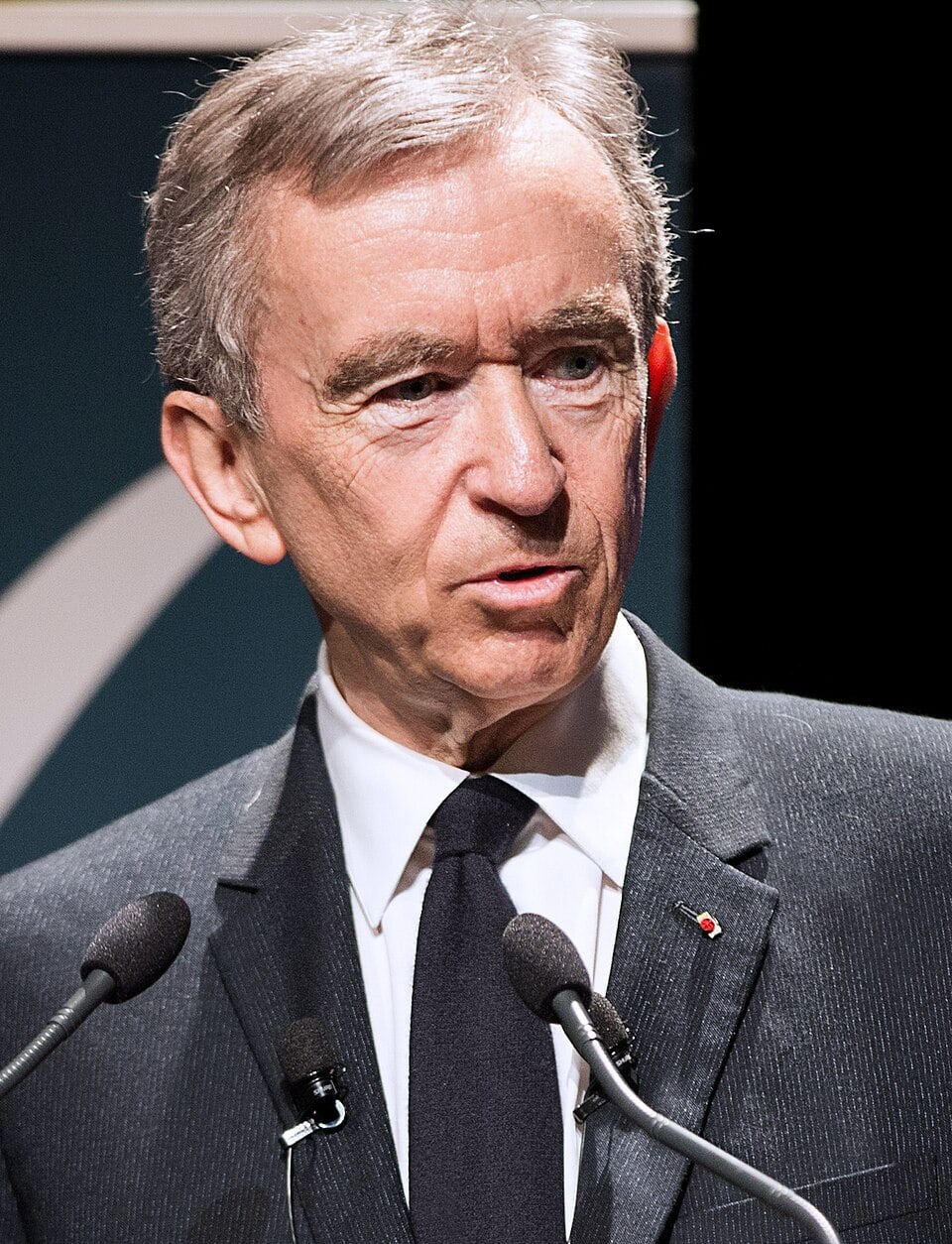
Bernard Arnault's net worth is estimated at $180 billion as of 6 November 2026. Almost all of it is a single asset: stock in LVMH, the Paris luxury group he has chaired since January 1989, whose houses include Louis Vuitton, Christian Dior, Tiffany and Co., Sephora and Moet Hennessy. He does not hold those shares in his own name. They sit in a chain of family companies that begins with a Belgian holding, Pilinvest, continues through Agache, and ends in a listed stake of 48 percent of LVMH carrying 63 percent of the votes. Everything else, a house in Paris, a yacht, an art collection and some outside investments, is small beside it and mostly undisclosed.
The number moves with the share price rather than with anything he is paid. LVMH is the largest company in the eurozone by market value, so a few percent on the Paris bourse shifts tens of billions of dollars on paper within days. Dividends add to his income but not to the headline figure, because much of that cash stays inside the holding structure.
This is an estimate of the market value of his holdings, not an audited statement of personal wealth. Forbes publishes the entry as "Bernard Arnault & family", so the total covers shares held for his five children as well as his own interest.
How the fortune was built
Arnault was born in Roubaix on 5 March 1949, the son of Jean Leon Arnault, an engineer who owned a civil engineering company called Ferret-Savinel, and Marie-Josephe Savinel, a pianist with a lifelong attachment to Dior. He was raised in a devoutly Catholic household and educated at Catholic schools in Roubaix and at the Lycee Faidherbe in Lille before reading engineering and mathematics at the Ecole Polytechnique, graduating in 1971.
He joined the family firm that year and was its president from 1978 to 1984. In 1974 he persuaded his father to leave industrial construction for property. The construction division was sold, the company was renamed Ferinel, and the real estate arm became the George V Group, whose assets were later sold to Compagnie Generale des Eaux and became part of Nexity. That sale gave a young developer the capital for what came next.
In 1984 he heard that the French government was seeking a buyer for Boussac Saint-Freres, a failing textile and retail conglomerate that happened to own Christian Dior. With Antoine Bernheim, a senior partner at Lazard Freres, behind him, Arnault took control of Financiere Agache and won the bidding with a ceremonial payment of one franc. He then cut 9,000 jobs in two years, earning the nickname The Terminator, and sold nearly every asset except the Dior brand and the Le Bon Marche store. By 1987 the business was profitable again, with earnings of $112 million on revenue of $1.9 billion.
In 1987 he worked with Alain Chevalier of Moet Hennessy and Henry Racamier of Louis Vuitton to create LVMH, a combination designed to be too large for a hostile raider. It proved no defence against a raid from within. In July 1988 Arnault provided $1.6 billion for a holding company with Guinness that held 24 percent of LVMH, then spent $600 million to buy 13.5 percent more and become the largest shareholder. In January 1989 he added $500 million to reach 43.5 percent of the shares and 35 percent of the votes, removed Racamier and was unanimously elected chairman of the executive management board on 13 January 1989.
Three decades of acquisitions followed. Celine came in July 1988; Berluti and Kenzo in 1993; Guerlain in 1994; Loewe in 1996; Marc Jacobs and Sephora in 1997; Thomas Pink in 1999; Emilio Pucci in 2000; Fendi, DKNY and La Samaritaine in 2001. Bulgari cost $5.2 billion in 2011. Tiffany and Co. was agreed at about $16.2 billion in November 2019, nearly collapsed in the pandemic, and closed in January 2021 at $131.50 a share. In April 2017 the Dior couture, leather and ready-to-wear lines were folded into LVMH, ending a split that had lasted decades.
Assets and holdings
The fortune is one structure, not a portfolio. In 1999 Arnault set up Pilinvest, two Belgian companies, and through them he holds 81 percent of Agache, the family holding company formerly called Groupe Arnault. Agache owns 48 percent of LVMH and 63 percent of its voting rights, and that gap between equity and votes is where his control lives. In December 2011 he moved a further 31 percent stake in Groupe Arnault, which the newspaper Liberation then valued at 6.5 billion euros, into Pilinvest. In 2022 Agache became a joint-stock partnership to keep control in the family.
A second thread runs through Christian Dior SE, the listed holding company he chairs. Since April 2017 the fashion house itself has sat inside LVMH, so Dior appears twice in the structure, once as a brand and once as a listed vehicle holding LVMH shares. The family also controls Financiere Agache, the operating arm through which the group's non LVMH investments, among them the Paris FC stake taken in November 2024, are held.
The rest is modest and largely private: a residence in Paris, the 101.5 metre yacht Symphony built by Feadship, and paintings by Picasso, Yves Klein, Henry Moore and Andy Warhol. He once owned Chateau Cheval Blanc, bought in 1998 with Albert Frere personally and sold to LVMH in 2009. Princess Yachts, Royal van Lent and the Carrefour stake held with Colony Capital sit with the group, not with him, which is why they are absent from the personal figure.
Income and the scale of the operations
The cash comes from dividends, not a salary. Arnault was paid 7.8 million euros as LVMH chief executive in 2016, a token sum for the head of a company that size. The real flow is the dividend on the LVMH shares held through Agache, and part of that is retained inside the holding rather than distributed, so the family's return has come mainly from the share price.
The operating base underneath is enormous. In the eleven years after he took over, LVMH's annual sales and profit rose fivefold and its market value fifteenfold. By 2017, the year he folded Dior into the group, sales had reached a record 42.6 billion euros, 13 percent above the year before, and net profit rose 29 percent. In May 2021 the group's market capitalisation touched 313 billion euros, then a record and the largest in the eurozone.
That is what funds the structure: about 75 houses, each run separately by design, whose cash pays dividends to Agache, which in turn supports the family companies. His own annual cash income is a rounding error next to the assets that produce it, and it moves with a dividend policy he influences rather than with any pay negotiation.
Where the money went
Most of it was never taken out. Cash generated in one part of the group paid for another: Bulgari at $5.2 billion in 2011, Tiffany at about $16 billion in 2021, and smaller houses before them. Personal money went into the holding structure rather than into consumption. In December 2011 a 31 percent stake in Groupe Arnault moved into Pilinvest in Belgium, six months before Francois Hollande, who had campaigned on taxing the wealthy, became president.
Tax is the most contested line. In 2013 it emerged that Arnault was applying for Belgian citizenship; he withdrew the request on 10 April 2013, saying he did not want it read as tax evasion and that he had refused employees who asked to go abroad for tax reasons. Le Monde reported that his 200 million euro pledge for Notre-Dame after the 2019 fire would not be deductible.
There were losses. La Tribune, bought in 1993, absorbed about 150 million euros and was sold in November 2007 to help pay 240 million euros for Les Echos. The web bets made through Europatweb from 1998 to 2001, among them Boo.com and Zebank, do not appear to have returned their capital.
Visible spending is thin: the 70 metre yacht Amadeus, sold in late 2015, and Symphony after it, plus rented aircraft since LVMH sold its Bombardier Global 7500 in October 2022.
What the records actually show
The ownership chain is documented. LVMH's filings show the Agache stake of 48 percent of the shares and 63 percent of the votes, and the Belgian companies and the Protectinvest foundation set up in 2008 appear in corporate registries. What is not documented is a personal balance sheet. No consolidated statement of the family's assets has been published, so the $180 billion is a valuation exercise, not a measurement.
The estimate is built by taking the LVMH market value, applying the family's economic interest and adding an allowance for private assets. The weak points are those private assets, which are not priced publicly, and the boundary of the family. Forbes pools the interests of five adult children under one entry, and no filing divides the total among them.
The professional estimates differ. As of December 2025, Forbes put the fortune at about $190.4 billion and the Bloomberg Billionaires Index at about $203 billion, a spread of more than 12 billion dollars on the same underlying shares. Earlier readings include $103 billion in July 2019, $240.7 billion in April 2023 and $218 billion in May 2024. Each was correct for its date, which is the point: the figure is a snapshot of a moving share price.
How that compares
Amancio Ortega, the founder of Inditex, is the closest parallel on networth.watch: another European who built a clothing empire from a single shop and still owns roughly 59 percent through Pontegadea. Ortega is estimated at $140 billion on 6 November 2026, forty billion below Arnault, and the shape of the two fortunes is similar, one dominant listed holding plus property. The difference is control: Ortega's 59 percent is a straight majority, while Arnault holds 48 percent of the equity and 63 percent of the votes, power that comes from a two class share structure rather than from the size of the stake.
The second comparison is Warren Buffett, at $158 billion on 3 November 2026, twenty two billion below Arnault. Berkshire Hathaway is a conglomerate of wholly owned businesses and a public stock portfolio, and his wealth is a claim on that mixture. Arnault's is a claim on one company in one industry, luxury goods, which makes it more sensitive to a single fashion cycle. Both men are in their seventies, both built their stakes decades ago, and neither shows any sign of selling down.
Net worth milestones
Six dated readings mark the path, and each one follows the LVMH share price rather than a change in what he owns.
- 1984 Buys Boussac Saint-Freres for one franc and with it Christian Dior, the asset the rest of the fortune rests on.
- 1989 Elected chairman of the LVMH management board on 13 January, aged 39, having spent about $2.7 billion to reach 43.5 percent of the shares.
- 1999 Sets up the Pilinvest holding in Belgium and is named the richest person in fashion, ahead of Amancio Ortega.
- 2019 Reaches $103 billion in July as the second richest person in the world, then briefly passes Jeff Bezos in December.
- 2021 Regains first place on 5 August at $198.4 billion as luxury sales surge in China and Asia.
- 2023 Peaks at $240.7 billion in April on Forbes figures, then falls to about $190 billion in June as Elon Musk overtakes him.
Legal history and later life
The record contains no criminal conviction. Arnault's legal history is commercial litigation and political controversy rather than prosecution. The hardest fight was Gucci, where LVMH quietly built 5 percent in 1999, was accused of a creeping takeover, raised its stake to 34.4 percent and was then diluted when Domenico De Sole issued shares to employees. It settled in September 2001, and LVMH sold out with a profit of about $700 million.
The second was Tiffany. In September 2020 LVMH said the agreed purchase was invalid and that Tiffany had mishandled the business during the pandemic; Tiffany sued to force completion, LVMH counterclaimed, and the parties settled in late October 2020 at $131.50 a share, 2.6 percent below the original price.
Two episodes are public argument rather than law. In 2013 he sought Belgian citizenship and dropped the request within days after it was read as tax avoidance. From 2010 to 2013 he sat on the board of advisers of the Malaysian fund 1MDB, a connection raised repeatedly since the fund became the subject of international investigations, though no allegation against him has been substantiated in any court.
He remains chairman and chief executive of LVMH at 77 with no date set for stepping down, though the handover has begun. All five children hold operating roles, and Delphine has run Christian Dior since 1 February 2023. The Protectinvest lock that barred them from selling family shares expired that year. His philanthropy is concentrated in art: he began the Louis Vuitton Foundation in 2006, Frank Gehry designed it, and it opened at the Jardin d'Acclimatation on 20 October 2014.
Frequently asked questions
How did Bernard Arnault make his money? He started with a family construction business in Roubaix and used the proceeds of its property arm to buy Boussac Saint-Freres in 1984 for one franc, which brought him Christian Dior. From that base he took control of LVMH in January 1989 and spent three decades buying luxury houses with the group's own cash and shares rather than with inherited or borrowed personal wealth.
Does Arnault control LVMH? Yes. His shares sit in Agache, which holds 48 percent of the equity but 63 percent of the voting rights, and the chain runs up through the Belgian company Pilinvest, in which he holds 81 percent. That voting position lets him set strategy and appoint management even though he falls short of a numerical majority of the shares.
Who will succeed him at LVMH? No successor has been named publicly. All five of his children work inside the group, and Delphine, the eldest, has run Christian Dior since February 2023, which the industry reads as preparation for a handover. The Protectinvest lock that barred the children from selling family shares expired in that same year, clearing the ownership question.
Why is his net worth below the 2023 peak? Because it is almost entirely LVMH stock. Forbes put the family fortune at $240.7 billion in April 2023, and softer demand for luxury goods since then has pulled the shares down. The $180 billion used here is the estimate for 6 November 2026 and would change with the next move in the share price.
What does he own outside LVMH? Comparatively little that is public. A residence in Paris, the 101.5 metre yacht Symphony, an art collection with Picasso, Klein, Moore and Warhol, and stakes held through the family companies. He sold Chateau Cheval Blanc to LVMH in 2009 and sold his first yacht, Amadeus, in late 2015, leaving the holding structure as almost the whole of the fortune.